

Anaplan maturity is not simply about how much of the platform an organisation has implemented. It is about how effectively the environment can be managed, improved and scaled as the business evolves.
Going live is only the beginning of an Anaplan environment’s journey. As it grows across models, users, data sources and business processes, the way it is supported needs to evolve too.
What starts as day-to-day application support can become a broader operating discipline, covering integration, change management, governance and continuous improvement. This is where Metora AMS helps organisations move beyond traditional support and build a more mature, resilient and scalable Anaplan environment.
When a planning environment is small, it can be relatively straightforward to understand how everything fits together. As it scales, however, managing it becomes more complex.
Data may come from an ERP, CRM, HR system, data warehouse or other business applications. That information may support multiple planning processes and models, while different teams use the environment in different ways. New requirements and changes continue to emerge.
The challenge is not simply managing more technology. It is managing the relationships between data, models, users, processes and business requirements.
As the environment expands, teams may introduce manual workarounds, develop inconsistent processes or become increasingly dependent on a small number of specialists. Changes can also become harder to coordinate, particularly when their impact extends across multiple models or teams.
These issues can develop gradually when the operating practices around the environment do not keep pace with its growth.
Maturity is about having the structure, ownership and expertise to manage that complexity.
Maturity develops through the way an organisation manages its environment over time. Four foundations are particularly important: reliable data, controlled change, clear ownership and governance, and continuous improvement.
Planning is only as dependable as the information supporting it.
As organisations connect Anaplan to more business systems, data needs to reach the right models in the right format and at the right time. Integrations also need to be monitored and maintained as source systems, models and business requirements change.
Anaplan Data Orchestrator supports this by enabling organisations to bring in data from external sources, transform it and map it to Anaplan models.
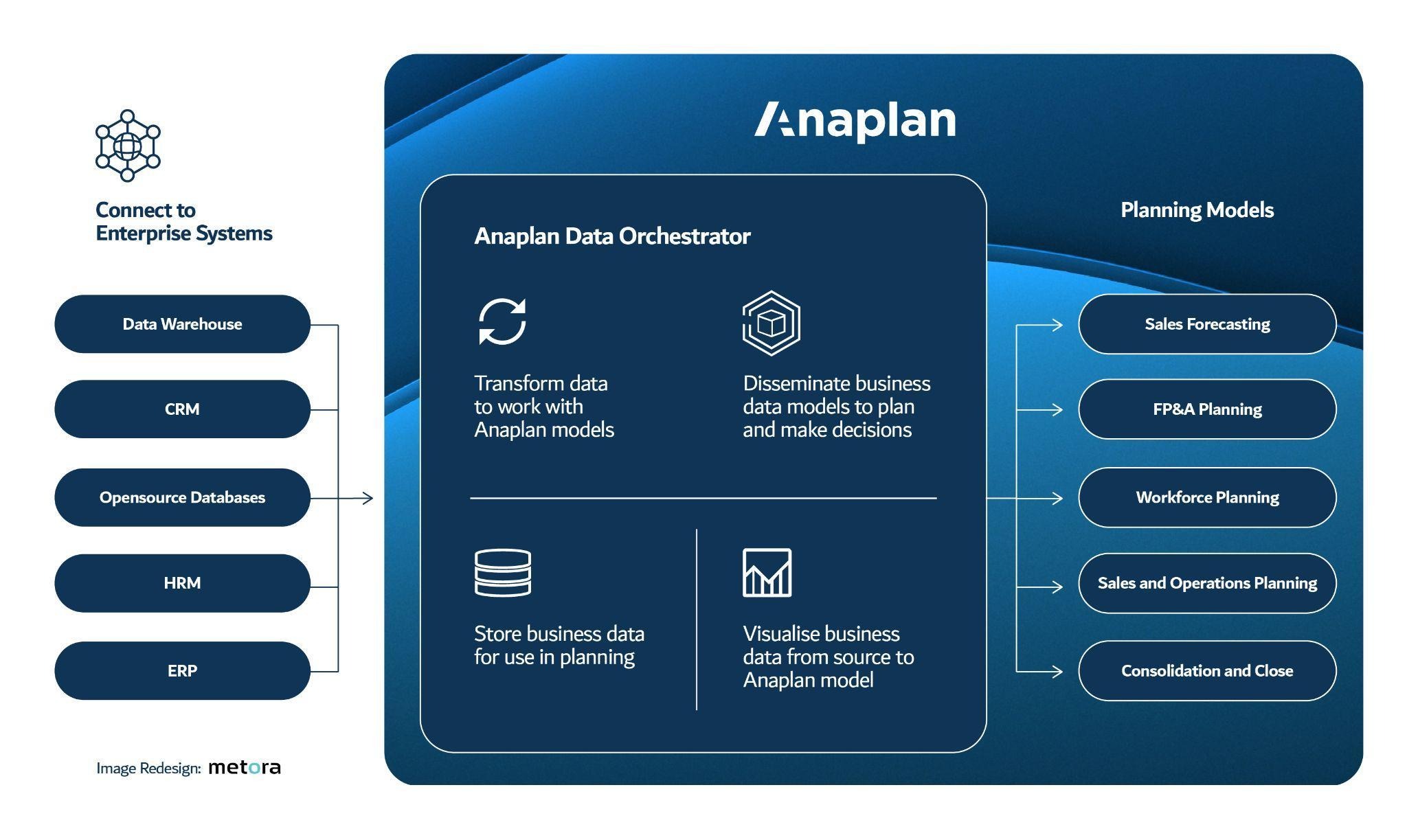
The diagram illustrates how data from multiple source systems can flow through Data Orchestrator and connect with different Anaplan models and planning applications.
The diagram highlights how a growing planning environment involves increasingly more connections to manage. Maintaining reliable data flows is therefore an ongoing responsibility, not simply a task completed during implementation.
Through Metora AMS, organisations can receive support with monitoring integrations, identifying recurring issues and managing changes as data requirements evolve.
Planning environments need to evolve. Models are refined, processes change and new requirements emerge. The question is how those changes are managed.
A mature environment requires a structured approach to development, testing and deployment. Anaplan’s Application Lifecycle Management (ALM) capabilities support this by helping teams manage model changes and test them before they are introduced into production.
The broader principle is that change should be managed as a process, not treated as an isolated request.
Metora AMS helps support this discipline by managing enhancements through structured development and testing, documenting changes and working with teams to introduce new requirements while maintaining control of the existing environment.
As Anaplan adoption grows, questions around ownership become increasingly important.
Who decides what should change? Who maintains the models? Who sets standards and documents key decisions? How is knowledge shared when responsibilities move between people or teams?
Center of Excellence (CoE) principles can help organisations establish clear responsibilities, governance, standards and knowledge sharing. The structure will vary between organisations, but the objective is consistent: to make sure the environment is not dependent on informal processes or a few individual specialists.
Metora AMS can complement an organisation’s internal CoE or planning team, bringing additional expertise and continuity while helping strengthen governance and operating practices. The aim is to work alongside internal teams, supporting and developing their capabilities.
Mature environments do more than maintain the status quo. They look for ways to improve.
This may involve refining a model, simplifying a process, improving the user experience, addressing recurring issues or making better use of existing functionality.
It represents a shift in the purpose of support. Instead of focusing only on resolving immediate issues, the question becomes: How can the environment become more stable, efficient and useful over time?
Metora works alongside planning teams to understand changing needs, co-create improvements, and keep the Anaplan environment intuitive and relevant as the business evolves.
The journey towards maturity can be understood as a progression:
Reactive support: The priority is resolving issues and keeping the environment operational.
Controlled operations: Processes become more structured. Changes are managed, responsibilities are clearer, and integrations are actively maintained.
Continuous improvement: The focus extends beyond immediate support to improving models, processes, user experience and governance.
Long-term maturity: The environment can evolve with the business, accommodate new requirements and support growth without losing control.
Metora AMS supports organisations throughout this progression, helping establish sound operating practices, refine existing processes and strengthen the environment as business needs change.
A larger environment is not necessarily a more mature one. The real measure is how confidently an organisation can operate and evolve it.
Can new requirements be introduced without unnecessary disruption? Are changes tested and controlled? Do teams understand how data moves through the environment? Are responsibilities clear, and is knowledge shared? Are recurring problems addressed rather than repeatedly fixed?
These are the practices that help an Anaplan environment remain aligned with the business.
Maturity is ultimately about what happens after implementation. It is the difference between keeping a platform running and helping it continue to deliver value.
Metora AMS helps organisations make that transition from reactive support to controlled operations, continuous improvement and long-term Anaplan maturity.
The goal is not simply to keep Anaplan running. It is to keep planning trusted, scalable and aligned with the business. With Metora AMS, your planning environment continues to evolve as your business does.
Enterprise Planning - Done Right