

The 2026 financial landscape has officially moved beyond the era of "static oversight." For the modern Chief Financial Officer (CFO), the mandate has shifted from protecting value to architecting it.
As organizations grapple with unprecedented data volumes and market volatility, the distinction between successful enterprises and those that falter lies in the ability to transform complex financial data into a high-velocity strategic asset. Enter: Financial Forecasting.
In the context of modern FP&A, Financial Forecasting is a continuous, connected process that combines actuals, real-time signals and forward-looking assumptions to guide decision-making.
Unlike a static budget, which serves as an aspirational roadmap, a forecast is an expectation-driven tool designed to predict the most likely financial outcomes such as revenue trajectories, cash flow requirements and profit margins, over a specific horizon. Forecasts also update continuously as assumptions change, requiring platforms that can recalculate plans instantly and at scale.
By leveraging advanced simulation tools to test the resilience of these projections against variables like supply chain volatility or macroeconomic shifts, the Finance function transforms from a reactive scorekeeper into a proactive architect of value. Ultimately, forecasting provides the real-time visibility necessary for CFOs to identify potential obstacles and opportunities long before they appear on a balance sheet.
The following roadmap outlines the essential shifts required for Finance leaders to move from reactive scorekeepers to proactive strategic partners.
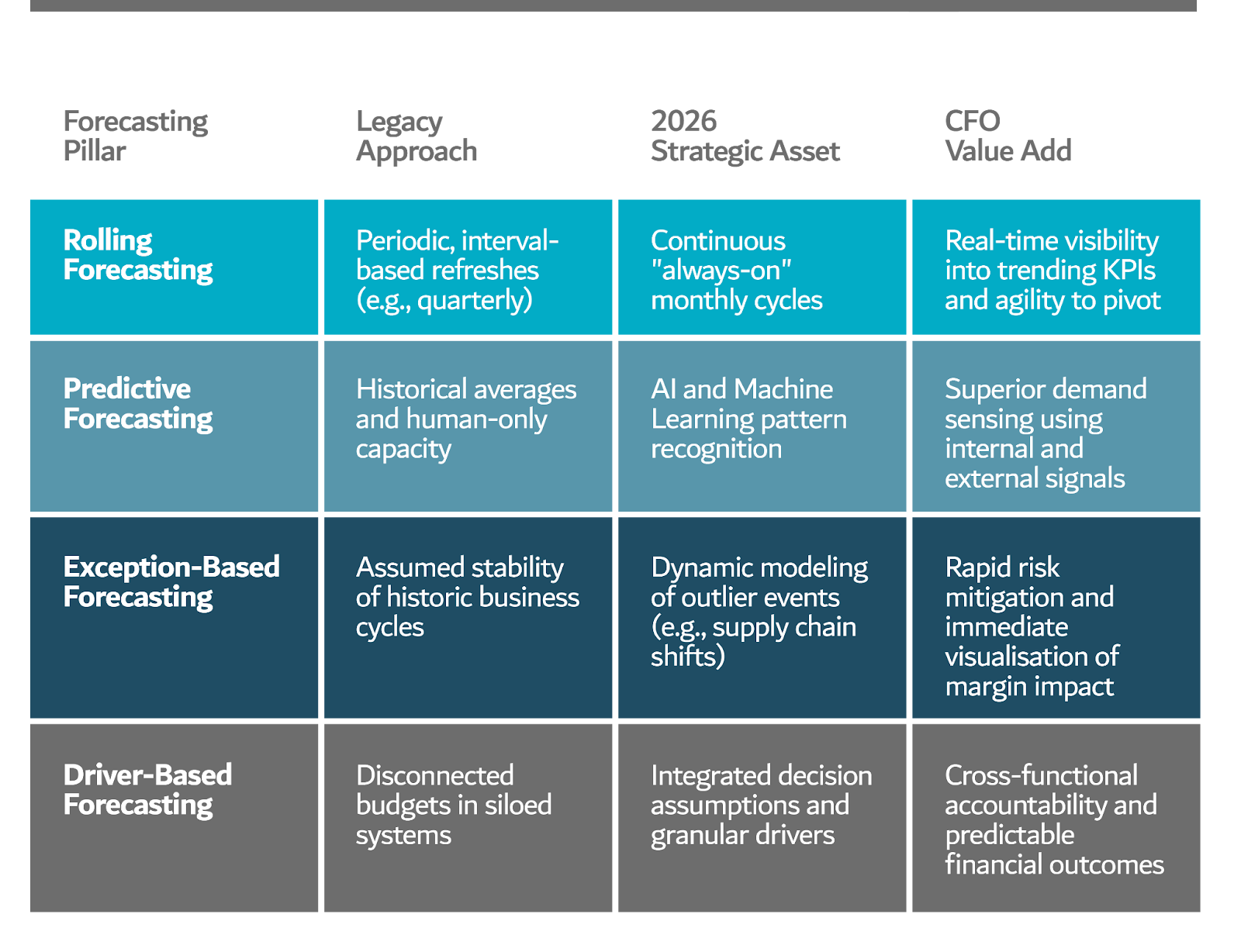
Always-on planning requires platforms that can ingest new data continuously and recalculate forecasts instantly - without manual model rebuilds. The traditional quarterly reforecast, often tethered to two historic and six forward-looking quarters, has become a liability in a world that shifts by the hour.
Cloud-native planning platforms enable CFOs to refresh forecasts continuously by connecting real-time operational and financial data in one model. By transitioning to a monthly rolling reforecast where the oldest historic month is dropped and the newest forward-looking month is added, organizations gain a persistent, real-time view into trending and rolling KPIs. This provides the agility to maintain a relevant, longer forward-looking horizon and react more efficiently to unforeseen events.
As data accrual exceeds human processing capacity, CFOs must augment analysis with intelligent tools. Predictive forecasting, leveraging Machine Learning and Artificial Intelligence (AI), allows Finance teams to recognise deep patterns in blended internal and external data.
These predictive capabilities are especially critical when interpreting fluctuating consumer demand, variable supply chains, and global macroeconomic factors. By producing localised intelligence and consuming intelligent operational forecasts, the Finance function can adequately participate in and drive strategic decision-making.
The high-performing forecasts of 2026 are defined by their ability to handle outlier events. With the breakneck pace of global evolution, historic business cycles can no longer be assumed to carry forward. Exception-based forecasting provides the adaptability to predictably cater to unforeseen events, mitigating risk while identifying hidden opportunities. It also allows finance teams to model outlier events quickly, assess their impact, and respond before risks materialise.
For instance, an international manufacturer facing port congestion can use these models to shift material purchases to domestic partners or alternative shipping methods like rail. With the right levers in place, a leader can instantly visualise the implications of these shifts on everything from timing to final margin. In other words, CFOs can instantly model how supply disruptions affect cost, margin, and cash - enabling faster, more confident pivots.
Perhaps the most foundational component of high-efficacy forecasting is the ability to dynamically layer assumptions or drivers into planning. Leveraging driver-based forecasting allows Finance to build a comprehensive financial picture based on specific decision assumptions.
This transparency allows the CFO to hold cross-functional counterparts accountable to predictable financial outcomes. If a scenario model reveals that a 5% reduction in a core product’s cost of goods sold (COGS) is the only path to an earnings target, the CFO can use that insight to fuel data-driven conversations with supply chain leaders to ensure the organization remains on track.
Here’s a breakdown of the modern techniques of Financial Forecasting that are designed to elevate every CFOs Financial strategy, stepping into 2026:
The move toward this roadmap - often powered by cloud-native platforms like Anaplan - is a non-negotiable upgrade for Finance leadership. By automating error-prone manual tasks and integrating disparate data models, Finance teams can close faster and shift expensive resources toward high-value strategic activities.
In 2026, the CFO’s role is no longer just about the numbers; it is about providing the clear, deep insights required for accelerated, smarter decision-making.
In 2026, the CFO’s role has shifted from defensive oversight to proactive value architecture. To thrive, finance leaders must move beyond reactive "scorekeeping" by adopting cloud-native platforms that automate manual tasks and integrate disparate data, allowing the organization to transform complex information into a high-velocity strategic asset.
Central to this roadmap is the transition to "always-on" planning through rolling and predictive forecasting. By replacing rigid quarterly refreshes with continuous monthly cycles and leveraging AI to identify deep market patterns, finance teams gain the real-time agility needed to navigate macroeconomic volatility and fluctuating consumer demand with precision.
Finally, the framework relies on exception-based and driver-based modeling to ensure operational resilience and cross-functional accountability. These tools allow leaders to instantly pivot strategies during outlier events and hold partners to predictable outcomes, ensuring that every financial decision is fueled by deep, actionable insights.
Looking to invest in Anaplan Financial Forecasting solutions? Get in touch.