

In an era of economic uncertainty, market volatility, and rapid business transformation, annual budgeting cycles are no longer sufficient to manage costs effectively. Designed for a more predictable environment, traditional budgeting struggles to keep pace with today's dynamic business landscape, where supply chain disruptions, inflationary pressures, shifting customer expectations, and technological change can alter business conditions within weeks.
For finance and operations leaders, the focus is shifting from static budgets to continuous cost decision-making. Powered by AI-enabled connected planning, organisations can move beyond reactive budgeting to continuously model scenarios, anticipate change, and make smarter cost decisions in real time. By combining AI-driven insights with connected financial and operational data, organisations gain the agility to optimise resources, respond faster to disruption, and protect profitability in an increasingly dynamic business environment.
Leading organisations are already embracing this approach, accelerating planning cycles, improving scenario modelling, and gaining the visibility required to direct resources towards the areas that create the greatest strategic value.
Despite significant advances in digital transformation, many organisations continue to manage planning through annual budget cycles supplemented by quarterly reviews and periodic forecasts.
While these processes provide structure, they often create several critical challenges:
When organisations operate with outdated assumptions, they risk making reactive decisions that impact profitability, operational efficiency, and long-term competitiveness.
The challenge is not simply a lack of data. Most organisations already possess vast amounts of operational and financial information. The challenge lies in connecting that data, transforming it into insight, and enabling decision-makers to act before circumstances change again.
Traditional planning processes often lack the connected data, automation, and AI-enabling capabilities needed to analyse planning drivers, identify emerging trends, and support faster decision-making. As a result, organisations often rely on historical information instead of forward-looking intelligence, limiting their ability to make proactive cost decisions.
Historically, cost management focused on controlling expenditure and reducing overheads. Organisations measured success through cost-cutting initiatives, budget adherence, and periodic efficiency programmes.
While cost discipline remains important, today's environment demands something more sophisticated: cost agility.
Cost agility is the ability to continuously assess changing conditions, understand their financial implications, and rapidly reallocate resources to the areas that create the greatest value.
Rather than asking:
"How do we reduce costs?"
Leading organisations are increasingly asking:
"How do we continuously optimise costs while supporting strategic priorities?"
This distinction is significant. Aggressive cost-cutting may improve short-term financial performance but can undermine innovation, customer experience, and future growth. Cost agility enables organisations to make balanced decisions that protect profitability while maintaining strategic momentum.
Cost agility is often discussed as a strategic aspiration, but what does it actually look like in practice?
Across industries, organisations that have embraced connected planning are achieving measurable improvements in how they plan, allocate resources, and respond to uncertainty. Planning cycles that once required months can be significantly shortened. Manual data consolidation is reduced through automation and a unified planning environment. Forecasts become more reliable because operational and financial assumptions remain continuously aligned rather than being reconciled at the end of a planning cycle.
Most importantly, leaders gain visibility into the drivers behind cost and performance. Whether evaluating workforce investments, operational expenditure, capital allocation, or growth initiatives, decision-makers can understand the implications of their choices before committing resources.
The result is a shift from retrospective reporting to proactive decision-making, enabling organisations to continuously optimise costs while maintaining business agility.
Achieving cost agility requires more than faster forecasting. It requires a fundamentally different approach to planning.
AI-enabled connected planning brings financial and operations planning into a shared environment, connecting areas such as workforce, project resources, software spend, sales, and supply chain planning where relevant. By combining connected enterprise data with AI-powered analytics, organisations can continuously evaluate business performance, predict potential outcomes, and make faster, more informed decisions based on real-time insights rather than static assumptions.
This interconnected approach delivers several advantages.
Leaders gain a comprehensive view of how changes in one area of the business affect others.
For example, rising labour costs can be immediately assessed against workforce plans, operational capacity, revenue targets, and profitability objectives. A change in customer demand can be evaluated across supply chain requirements, staffing needs, and financial performance simultaneously.
AI enhances this visibility by continuously monitoring business drivers, detecting anomalies, and surfacing insights that enable leaders to respond before issues escalate.
Connected planning significantly reduces the time required to gather, validate, and reconcile data.
Rather than waiting for monthly reports or quarterly reviews, leaders can access up-to-date insights and evaluate alternative scenarios in real time.
AI-enabled planning supports scenario modelling by helping teams evaluate multiple assumptions faster, compare possible outcomes, and identify better-informed options based on changing business conditions.
Finance, operations, HR, and business teams work from a single source of truth, reducing inconsistencies and improving organisational alignment.
Decisions become enterprise-wide decisions rather than departmental decisions.
Instead of relying on static annual budgets, organisations can continuously update planning assumptions, forecasts, and resource allocations as business conditions evolve.
With connected data and AI-enabled insights, planning becomes more dynamic. Teams can update assumptions, refresh forecasts, and make more timely cost decisions as business conditions change.
Artificial intelligence is transforming planning from a reporting function into a strategic decision-support capability.
Traditionally, forecasting involved analysing historical trends and projecting future outcomes based on predefined assumptions. While useful, this approach often struggles to keep pace with rapidly changing business conditions.
AI-enabled planning platforms are changing this dynamic.
By analysing large volumes of financial and operational data, AI can identify patterns, detect anomalies, and generate predictive insights that would be difficult to uncover through manual analysis alone. Forecasts become continuously updated, enabling organisations to identify emerging risks and opportunities sooner.
AI-enabled planning helps organisations move beyond forecasting by giving leaders better insights into the likely impact of different decisions.
Rather than simply predicting what may happen, AI-enabled insights and scenario modelling enable leaders to evaluate the likely outcomes of different decisions before they are made. By modelling scenarios such as shifts in demand, workforce requirements, supplier costs, or investment priorities, organisations can compare alternative courses of action and make more informed, confident decisions.
This allows finance and operations leaders to spend less time gathering information and more time evaluating strategic options.
For many organisations, workforce expenditure is one of the largest and most important controllable cost categories.
Yet workforce planning often remains disconnected from financial planning, creating gaps between strategic objectives, resource requirements, and budget allocations.
Connected planning bridges this divide by bringing together headcount, position-level plans, hiring, turnover, internal mobility, skills, workforce costs, capacity, productivity, and financial outcomes within a single planning environment.
Leaders can model hiring scenarios, assess workforce gaps, evaluate productivity impacts, and understand the financial consequences of talent decisions before implementation.
This integrated approach enables organisations to optimise workforce investments while ensuring they have the capabilities required to execute their strategy.
Workforce planning provides one of the clearest examples of connected planning in action. Rather than relying on annual headcount budgets that quickly become outdated, organisations can continuously align workforce decisions with business objectives. By connecting finance, HR, and operational planning through a shared data foundation, leaders gain real-time visibility into workforce costs, capacity requirements, and future resource needs, enabling faster and more informed decisions.
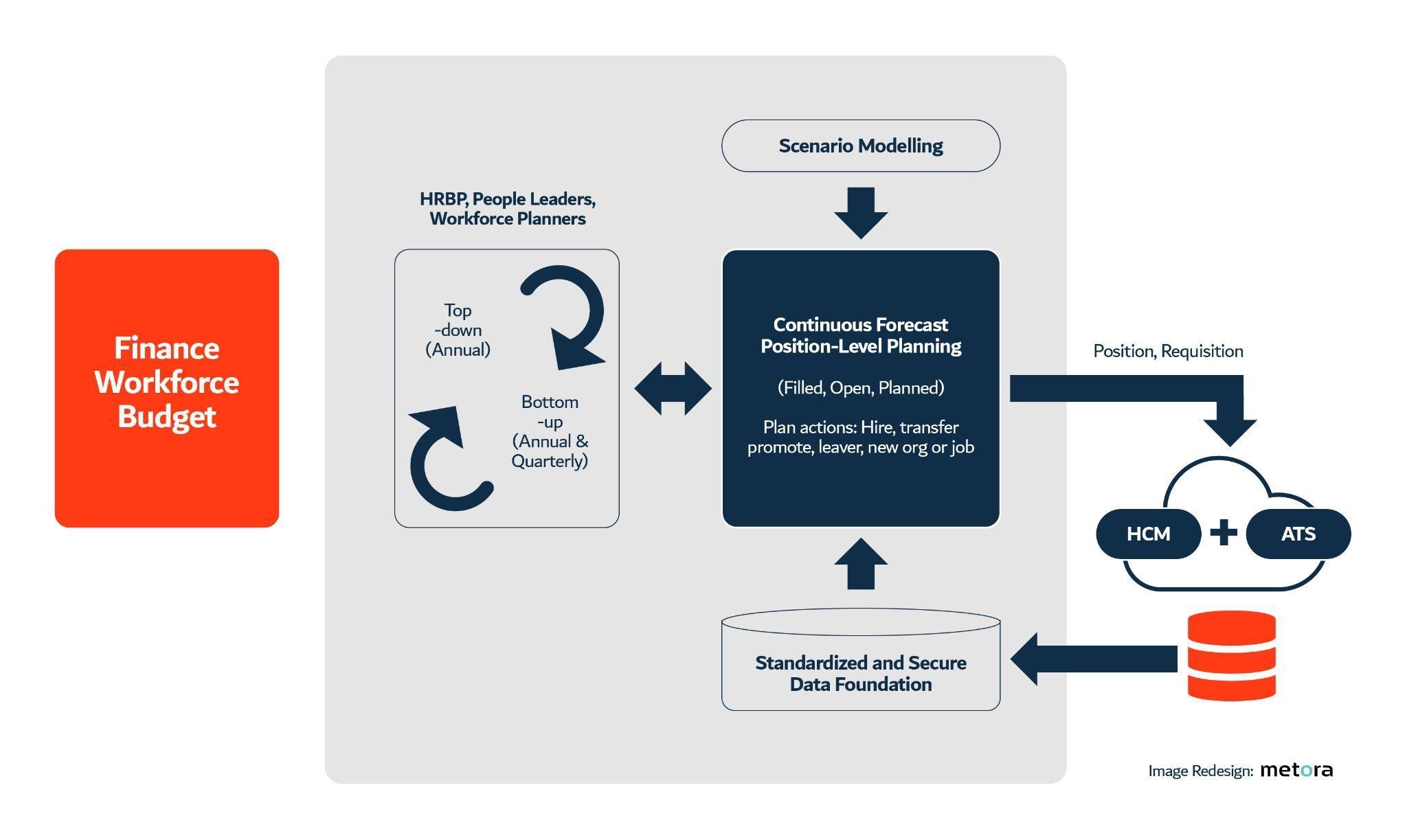
Cost agility extends beyond traditional budgeting processes.
Project portfolios, software contracts, software subscriptions, and operational expenditures all require continuous evaluation to ensure resources are directed towards the highest value.
In many organisations, software and technology expenditure continues to grow, yet visibility into utilisation and business value often remains limited.
Connected planning enables leaders to evaluate spending decisions across the enterprise, identify underutilised investments, and reallocate resources more effectively. Rather than conducting annual cost reviews, organisations can continuously assess spending against changing business priorities and market conditions.
The objective is not simply to reduce expenditure. It ensures that every investment contributes to strategic outcomes.
Technology alone does not create cost agility. Organisations require a planning framework that connects strategy, finance, and operations while ensuring adoption across the business.
As a leading Anaplan partner in Malaysia, Metora helps organisations move beyond siloed planning processes and fragmented spreadsheets to create a truly connected enterprise.
Leveraging Anaplan's AI-enabled Connected Planning platform, Metora enables organisations to unify financial, operational, workforce, and strategic planning within a single environment. This provides decision-makers with the visibility, agility, and intelligence required to respond confidently to changing business conditions.
By combining connected planning, scenario modelling, and AI-enabled insights, organisations can:
The outcome is not simply a more efficient planning process. It is a fundamentally different way of operating, one where decisions are informed by connected data, aligned across functions, and continuously refined as conditions evolve.
Static budgeting is no longer enough for organisations operating in fast-changing conditions.
As business environments become increasingly dynamic, organisations require planning processes that continuously adapt to change. AI-enabled connected planning combines scenario modelling, predictive insights, and enterprise-wide collaboration to transform planning from a periodic budgeting exercise into a continuous decision-making capability.
For finance and operations leaders, the objective is no longer simply controlling costs. It ensures that every cost decision supports strategic outcomes, strengthens resilience, and protects profitability.
The advantage no longer lies in producing a static annual budget. It lies in using connected planning and AI-enabled insights to evaluate scenarios, optimise resources, and make confident cost decisions as business conditions evolve. Organisations that embrace AI-enabled connected planning will be better positioned to improve resilience, accelerate decision-making, and sustain long-term growth.
Those who embrace connected planning today will be better equipped to navigate uncertainty tomorrow, transforming cost management from a reactive exercise into a strategic advantage.
In the new era of business planning, success will not be determined by who creates the most accurate annual budget. It will be determined by who can make the fastest, smartest, and most informed decisions when conditions inevitably change.
The organisations that win tomorrow won't be the ones with the best budgets! They'll be the ones who make the best decisions. Discover how Metora helps businesses turn connected planning into a competitive advantage.