

An Anaplan model can go live successfully and still, over time, begin to fall behind the business it was built to support.
Planning cycles evolve. Teams reorganise. New reporting requirements emerge. Data volumes increase. Users develop new expectations, and business processes change. Yet many organisations continue to treat their Anaplan environment as though implementation marked the end of the journey.
It does not.
The real question after go-live is not simply whether the model is still running. It is whether it is still evolving with the business.
When it is not, the warning signs are often familiar. Users continue to rely on Excel. Planning cycles still feel painful. Enhancements take too long to implement. Existing dashboards are underused. The model no longer reflects current organisational realities. Support becomes focused on resolving recurring issues rather than helping the environment move forward.
These may appear to be separate problems. In reality, they are often connected symptoms of an Anaplan environment that is no longer being continuously reviewed, maintained and improved.
This is where Metora Anaplan Managed Services (AMS) can play a much broader role than basic ticket support.
Metora AMS is designed to provide continuous post-implementation support that helps keep Anaplan aligned with changing business needs. Rather than simply responding when something breaks, the focus is on maintaining model health, improving performance, managing enhancements, supporting users, and helping the wider planning environment continue to evolve.
Model deterioration is rarely a single dramatic event.
A calculation may start taking longer. A dashboard may gradually become cluttered. An integration may require more manual intervention. A new business requirement may be addressed through a workaround because changing the existing model is considered too difficult or time-consuming.
Over time, these individual compromises can accumulate.
Anaplan's Model Optimization Checklist reflects the breadth of this challenge. Performance can be affected by multiple aspects of model design, including lists, modules, line items, formulas, actions and time settings. Optimisation, therefore, is not simply about finding one problematic formula when users complain that the model is slow.
It requires a structured view of the environment.
That matters because model performance is not only a technical issue. If users are waiting for calculations or pages to load, planning can slow down. If reporting is difficult to use or no longer reflects how the business works, people may create their own spreadsheets and side calculations. If enhancements take too long, the gap between the system and the business can widen further.
This can create a self-reinforcing cycle in which declining model performance drives greater reliance on manual workarounds, weakens user confidence, reduces adoption and ultimately contributes to fragmented planning.
This is why Metora's approach to AMS starts with more than the individual issue in front of the support team. It considers whether the wider Anaplan environment is still supporting the way the organisation plans today.
Anaplan's Layers of Review framework provides a useful way to understand why effective optimisation should not begin and end with technical troubleshooting.
A meaningful review starts with the business and the people using the environment, then moves through increasingly detailed assessment of model design, optimisation opportunities and performance under real-world conditions.
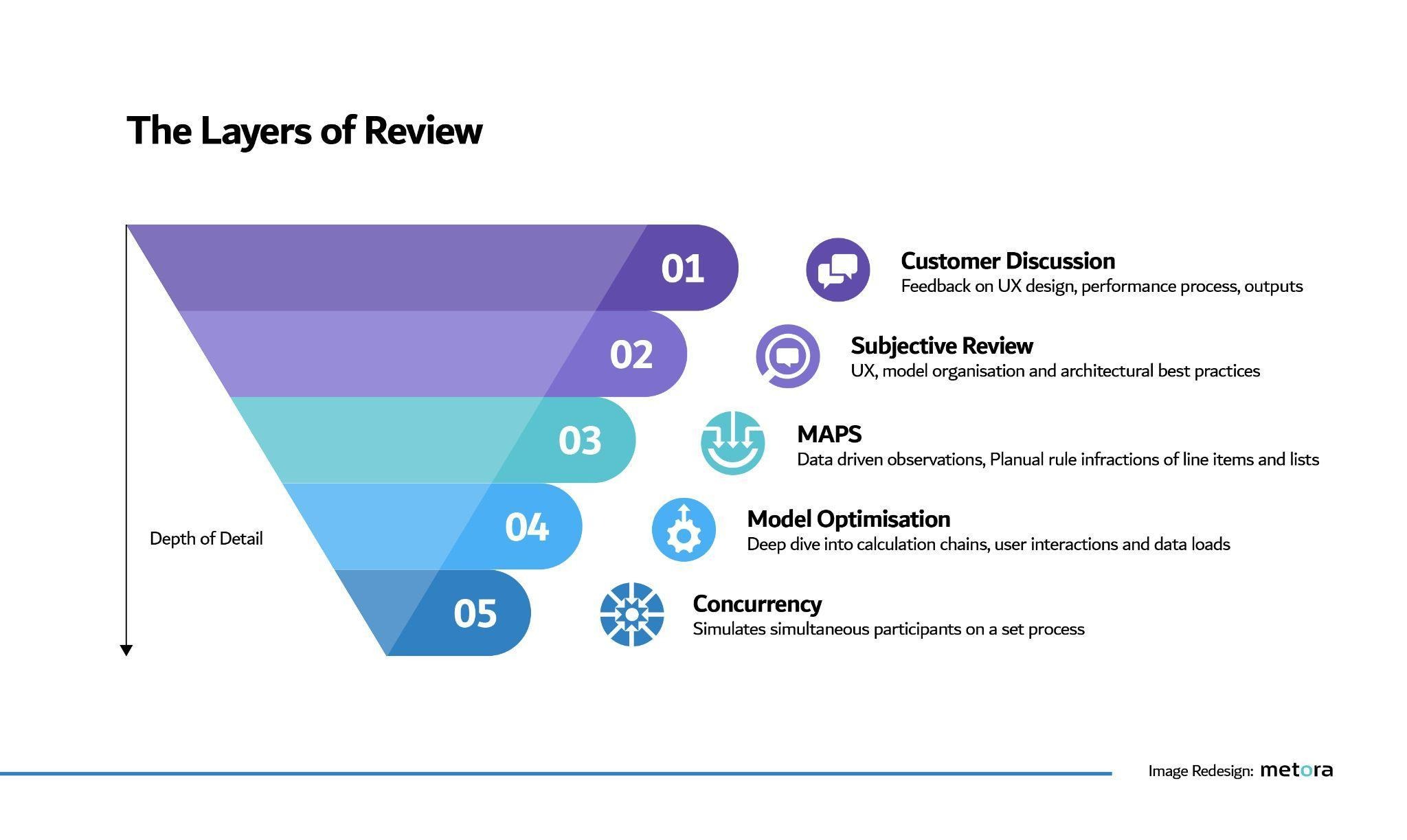
The diagram is particularly relevant to post-implementation support because it recognises that a model can be reviewed from several perspectives.
The first question is not necessarily, “Which calculation is causing the problem?”
It may be:
“What has changed in the business, and is the Anaplan environment still supporting it effectively?”
For Metora AMS, this layered approach provides a useful foundation for continuous improvement.
The first layer is understanding how the environment is actually being used.
A planning model is built around a point-in-time view of the organisation: its processes, structures, data sources, planning cycles and decision-making requirements. But those requirements do not remain static.
A company may enter new markets, restructure teams, introduce new products or change how it forecasts and reports. If the Anaplan environment does not evolve alongside those changes, users can begin adapting around the system instead of working through it.
This is also where user adoption becomes a critical part of model health.
Anaplan UX best practice guidance emphasises that dashboards and pages should be designed around clear user needs. When pages become cluttered, outdated or difficult to navigate, users can become overwhelmed, make errors or abandon the tool altogether.
In practice, the warning sign may not be a formal complaint.
A user may simply export the data to Excel.
Metora AMS helps address this by treating user adoption and UX as part of the ongoing environment, not as something completed at go-live. Dashboards can be reviewed, user needs can be reassessed, and changes can be made as planning processes evolve.
Once the business and user context is understood, the next step is to look at what sits behind it.
This is where data and integration, model optimisation and workflow management become connected parts of the same AMS conversation.
A slow dashboard may reflect more than a UX problem. An integration issue may reveal that the underlying data process has changed. A painful planning cycle may be caused by the interaction between model design, workflows and user behaviour.
Metora's AMS service scope is designed to address these areas as part of a wider post-implementation environment:
The value of this approach is that it connects individual support needs to the bigger picture.
Metora is not simply asking, “How do we close this ticket?”
The more important question is, “What does this issue tell us about the health and evolution of the wider planning environment?”
Many organisations only investigate model optimisation when the problem becomes impossible to ignore.
A planning cycle becomes noticeably slower. An integration fails. Users stop using a dashboard. A critical enhancement takes too long.
By then, however, the visible issue may be the result of smaller problems that have been developing over time.
A more effective AMS approach is to create an ongoing cycle of review and improvement.
That means regularly asking:
This is the practical difference between ticket support and continuous planning support.
A reactive support approach resolves issues after they appear. Continuous AMS helps identify where the environment may be beginning to drift before that drift has a greater impact on adoption, performance or planning confidence.
It also creates the capacity to move the environment forward. As organisations explore newer Anaplan capabilities and increasingly expect faster scenario analysis, automation and more responsive planning, the underlying environment still needs to be healthy enough to support those ambitions.
New capabilities alone do not create continuous value. The model, data, processes and user experience must continue to evolve with them.
Your Anaplan environment was built to be used, not simply deployed.
Without continuous attention, even a successful implementation can gradually lose momentum. Planning slows. Enhancements become harder to deliver. Users rely on workarounds. Adoption declines. Internal dependency increases, and confidence in the planning environment can weaken.
The alternative is not simply more support tickets.
It is a more structured approach to post-implementation value.
Through continuous model optimisation, faster and more targeted enhancements, ongoing user support, stronger data and integration management, and proactive advice and governance, Metora AMS helps organisations keep their Anaplan environment aligned with how the business operates today.
The goal is to unlock more value from Anaplan over time, not through one major intervention, but through continuous improvement across the environment.
One important measure of a successful implementation is whether the model continues to work as the business changes.
Your Anaplan model went live. But is it evolving with your business?
Talk to Metora about reviewing your current Anaplan environment and identifying where continuous AMS support can help maintain model health, improve adoption and unlock greater planning value.